
Design at Remote
Q&A with Gregor Matheson, Director of Product Design.

Dear readers,
In this Q&A article with Gregor Matheson, Director of Product Design at Remote, we speak through an honest account of how the design team hire, how they work, and where they’re heading.
I’m fascinated by companies that scale remotely and build a company of note, with employees in multiple countries around the world. The design team spans 45+ people across 20+ countries and consistently maintains a high standard of work.
In a world where companies expect 5 days a week onsite again, companies like Remote stand out to me as an example of the power of remote work.
3 learnings from this article:
Every designer at Remote has shipped code to production, including leadership — This is exactly where the industry is heading and what “Product Designer” means going forward.
Design system documentation now doubles as agent instruction manuals to train AI to build correctly within the system.
There is true buy-in from C-level, with the VP of Design reporting into the CEO, this is rare for a company the size of Remote, so this is worth noting as a company who care about design.
Intro to Gregor:
Gregor is a design leader who believes in thoughtful and holistic design, executed with consideration and craft. With over 15 years experience, Gregor brings in-depth knowledge of design, user experience, strategy and design leadership to help build operationally-excellent organisations adored by customers, envied by competitors, revered by the industry and advocated by employees.

1. How is the Design team structured at Remote?
Remote is an async-first company and our Design team is comprised of 45+ individuals across Product Design, Design System, Content Design, Brand Design and Design Leadership — spanning 5 continents, 20+ countries and 13 time zones. The majority falls within EMEA, but we’ve got designers worldwide — from California to India to Japan to New Zealand.
The entire company prioritises asynchronous communication, with a heavy reliance on documentation, be it Notion, Looms, Linear or Slack etc. We work fluidly rather than following rigid methodologies, so there are no daily stand-ups or two-week sprint cycles. Instead, we encourage continuous delivery and impact, empowering teams to think big, ship small. Each PDE team (Product, Design, Engineering) is the collective owner of their domain — there is no fixed way of working, so each team is empowered to operate the way that works best for them.
2. How do you maintain a sense of team culture within design when you are so distributed?
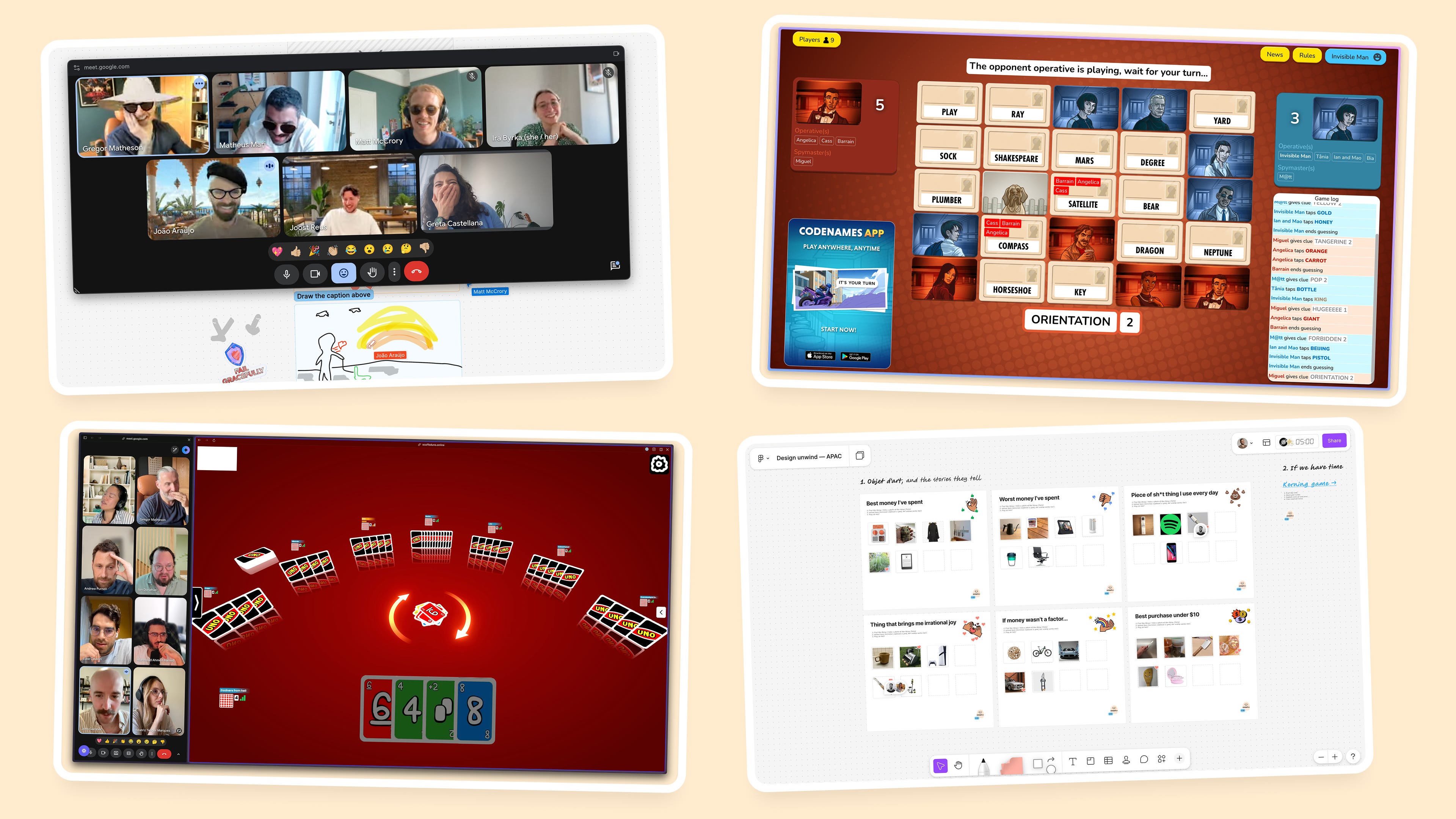
Connection and collaboration aren’t impossible without an office; it just requires more intentionality. In Design, we all share one global board to track all work and conduct an async planning and reflection ritual each week where we set objectives, identify opportunities for collaboration, and share learnings. For socialising, we have a rotating Design Unwind every two weeks, and we host a Design All Hands every two months. Many of the team also have regular coffee chats with their peers.
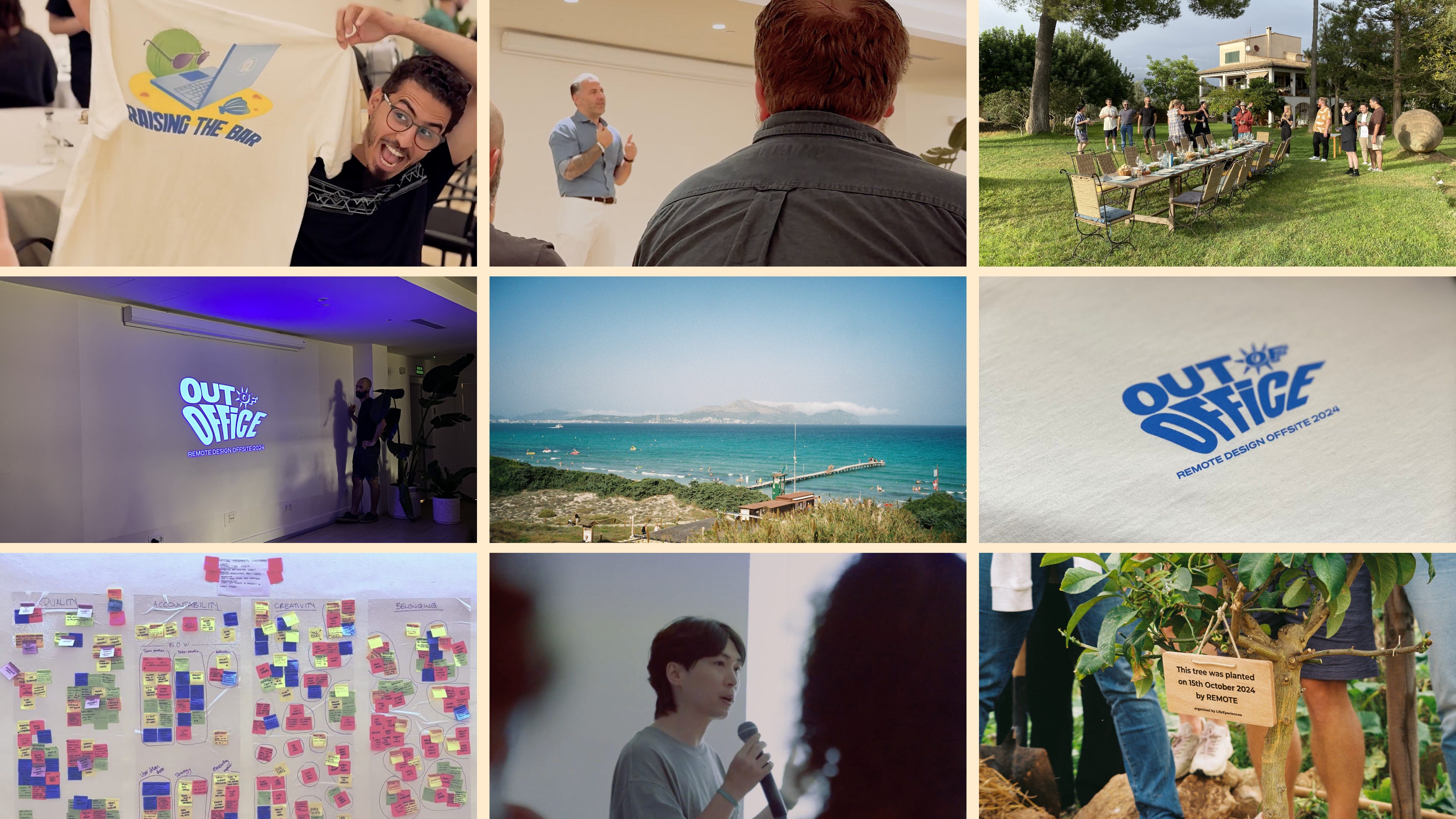
And while it is not a recurring event, we previously hosted a Design Offsite, bringing the entire team from around the world together for a few days of connection and collaboration. Additionally, no matter where you travel, you’re never far away from a Remoter, so there is always ample opportunity to meet colleagues.
3. How does Remote measure design success?
We don’t have any specific measures of design success at Remote. Instead, all teams have the autonomy to define what measures are most impactful to their domain. Some teams are more data-informed than others by proxy. Some teams are well-established. Some teams are 0→1. Having one prescribed set of measures to suit all teams rarely works.
Personally, I’ve never understood why people attempt to define separate measures for design success vs. collective success. We work cross-functionally, we all want to solve customer problems, and we all have vested interests in making the business successful — so why would you need a specific measure for design? I find it redundant, especially since you can rarely affect that measure solely within Design without your Product and Engineering peers.
4. How does Remote interview designers?
All designers work in cross-functional trios, and since your peers may be on the other side of the world, we need to understand how you will adapt to our async environment, as frankly, working this way doesn’t suit everyone. Our recruitment process may appear longer-than-usual, but it’s only to ensure you’re the right person for the team — and that Remote is the right environment for you too.
Recruiter interview — an initial conversation to discuss your background, experience, what you’re looking for, and alignment with Remote.
Future manager interview — an in-depth discussion with a member of design leadership to explore your experience, your approach, and how you work.
Case study and review (async) — you’ll record a presentation of a case study you’re most proud of, demonstrating your process and impact, which we assess async.
Group interview — a meeting with other designers and cross-functional peers to discuss collaboration, ways of working, and team dynamics.
Bar-raiser interview — a discussion with a Remoter outside of Design to understand how you align with our values and async ways of working.
Executive interview — a final interview with our VP Design.
Every candidate must have an up-to-date portfolio when applying. These are shortlisted and reviewed by design leadership before they even reach the Recruiter Interview. We aren’t looking for perfection at this step, but there’s got to be an immediate demonstration of high-quality craft to spark enough intrigue to warrant a call.
All of our job roles are ever-green and not specific to a team. This is part design, part necessity. We are not only looking for the right designer, but the right person — so we prefer to pair your skills, experience and chemistry to the right team, in alignment with organisational needs and business priorities. Additionally, we can hire anywhere, so managing multiple vacancies for every country in the world would be an administrative and logistical challenge.
Everything you could possibly want to know about what we look for can be found in this article I wrote for Remote’s blog following our AMA event. All details about our Total Rewards package are available in our public handbook, including all geo pay ranges.
5. Who thrives at Remote? And who is it not for?
Remote is not for everyone, nor do we want it to be. I typically finish interviews with my ‘here’s why you might not like Remote’ list:
It’s an intense pace - we’re an ambitious, high-growth tech company, so you need to be prepared to work hard and attack your work. While it is intense, you will probably be the most productive you’ve ever been in your career. I’ve got more to show from my 2 years at Remote than the 5 years prior combined.
We value taking swings over data and research - if you’re a designer who enjoys getting lost in weeks of user research, you will not enjoy Remote. We’re building an HR platform, and due to its globally-async nature, Remote is a very good stress-test. Everyone uses our own platform, so we gather lots of feedback internally — colleagues, people managers, leadership, as well as the People, Finance, Legal and Operations teams. If it doesn’t work for them, it won’t work for customers. So if your team has a compelling vision and it excites your peers internally, let’s take that swing.
We have a high-performance culture - a lot of companies, especially very large ones, have cultures where mediocrity can easily hide. At Remote, everyone is held to a high level of accountability and performance. We also have a culture of transparency and no surprises — if something isn’t going according to plan, you will know about it. And equally, if you demonstrate your potential, you will be encouraged, pushed and supported to go for the next step.
You will receive top-down direction - our organisation is pretty flat and leadership are expected to be in the weeds of the work. As a designer, you will get a lot of top-down input and direction. As leaders, we are typically viewing things through a more strategic lens and have a more holistic view of platform experiences — it helps identify areas of collaboration, but we are also in our positions to maintain the bar for quality.
It requires self-discipline - there are no office opening hours, nor is there a lull in the day when things get quiet. When I am finishing my day, many of my colleagues are starting theirs, there is no inbox zero at Remote. It requires self-discipline with your boundaries and time management. During onboarding, everyone is encouraged to design their calendar to suit them — and we mean it. Some people are morning people, some are night owls, some have parental responsibilities, and everyone is in different time zones. You are given the autonomy to own your time.
Most candidates like the sound of the above on the surface, but not always the reality. These are the reasons I love Remote. I’ve experienced the antithesis in other organisations. If the above doesn’t resemble what you want and enjoy, no harm done; neither party is wrong.
6. How is the Remote design team using AI?
As of March 2026, every designer at Remote has shipped code to production, including design leadership, the majority of whom had little to no experience doing so prior to Remote. We’re not the first to this dance; this is not a gimmick that stops here, nor is that a hugely shocking statement to read in 2026, but it’s a statement of intent and expectation. Most of the team had not even opened Claude Code or Cursor until this year. That’s the velocity of evolution occurring in the industry right now.
Remote is investing heavily in AI; there is no ‘buy-in’ required. Our founders and leadership are incredibly passionate, everyone has access to a plethora of AI tools, and we’ve removed the barriers to entry to enable everyone to ship code. In fact, I can’t even remember the last crit that took place in Figma; almost all are either AI prototypes or viewing a branch in a staging environment.
We’re not just experimenting either, the use of AI is already having tangible business impact. During a recent hackathon, a tiny team went from zero → AI-powered survey creation tool in 3 days. After some post-hackathon iteration, this tool is now fully embedded into the Remote platform, adopted by our own People team (allowing them to ditch an expensive third-party tool) and is available to Remote customers today.
Remote has always been highly collaborative, but AI is supercharging this collaboration even further. Now anyone can prototype an idea, fix bugs, whip up their own branch, or even build a feature. It is accelerating the collaboration further and faster — and in time, helps us spend more time focusing on two important things: ensuring the problem is being solved, and execution of the experience.
7. What is Remote's stance on design systems and AI?
With design systems, our stance is that AI doesn’t replace design thinking, it just handles the production, so designers stay in the decision-making seat. For design, it’s amplifying a team of 1 to operate like a team of several.
We’re rebuilding our design system from scratch at the moment while product teams keep shipping, and honestly, AI has our biggest collaborator. Be it authoring components, generating documentation, auditing token architecture, checking for WCAG contrast issues or inconsistencies, linting, or mapping old componentry to new - what used to take days now takes a fraction of that time.
The documentation used for Design and Engineering doubles as agent instruction manuals to train AI to build within the system correctly. And through MCP integrations like Figma, Slack, Notion, and Git, everything stays synced without the historical manual overhead. The barriers that used to exist are dissolving.
8. How will you maintain high standards as you grow?
One of our values at Remote is Excellence, so we’ve always had a strong focus on quality, and we try to democratise the ownership of quality where possible. Our crits, experience reviews, async feedback reviews and dogfooding are not only cross-functional but attended and contributed to by wider stakeholders from our People, Legal and Operations teams. Design leadership is intimately involved in their teams’ work, collaborating closely to drive progress toward impactful outcomes. There’s no helicopter parenting here.
The entire industry is entering a new paradigm where everyone is a builder. When everyone can ship, maintaining quality is a challenge nobody has really had to contend with before. I don’t think ‘the way’ of working has been established yet. That said, we’re not waiting for perfect. We’re jumping in with both feet to experiment, learn, optimise and innovate as we go and by doing so, the guardrails required will rise to the surface. For example, all merge requests have always been reviewed by Engineers, so adding Designers to these are an easy, non-regrettable change. Additionally, we’ve always had Engineering support rotations, which will now be PDE rotations where Product Managers and Designers are also included. It’s new for everyone, but it helps democratise the ownership of quality and fixing of problems.
9. How is design viewed at the CEO level?
We are very fortunate to have a CEO who is incredibly passionate and has a great eye for design quality. Our VP Design reports directly into our CEO, Job, and as such, he and other members of senior leadership will frequently review ongoing work, provide feedback, build their own prototypes and leave comments.
I’ve never once had a ‘seat at the table’-like conversation during my time at Remote. Everything operates as a cross-functional PDE org from leadership down to product teams. Sure, there are debates and trade-offs to be made but everything is discussed as PDE - which is something I definitely don’t take for granted when I talk to friends in the industry who experience the opposite.
10. What is Remote building that truly matters?
We spend most of our lives at work, and most people interact with an HR platform they have to use, whereas we want to create an HR platform people love to use. Our mission is to make it simple to find, hire, manage and pay anyone, anywhere - helping customers ditch numerous, costly third-party tools and consolidate into one platform that enables employers to manage their workforce and employees to manage their employment.
However, what an HR platform has looked, felt and done until now and what it looks, feels and does in the near future, will be very different. And we’re on the precipice of reinventing what the future of work looks like, again - so stay tuned.
Thank you to Gregor for this superb walk-through of the design team at Remote. If you’re interested in doing some incredible work in a forward-thinking company (and work fully remote!), they are hiring for a few design roles:
Senior Staff Product Designer (Reporting to Pedro Marques, VP of Design)
Here are a few other links to check out: