


The Economist is a legendary company. In my series of going behind the scenes of design teams, I didn’t want it to be only focused on AI-startups but companies like The Economist who are nearly 2 centuries old (who have been through many disruptions!) and how they are adapting to the world of AI.
Here’s just a small number of takeaways I took from this article:
Earlier this year, they transitioned to a rolling three-month roadmap to remain agile and reduce planning overhead.
Design success is measured by business impact engagement, retention, and Lifetime value, not vanity metrics.
Their design system Marber (named after Romek Marber, the distinguished graphic designer) is bridging Figma and AI tools like Cursor to help get richer prototypes that capture design intent.
AI isn’t replacing designers at The Economist, it’s making them more productive.
In this article I am speaking with Adam Morris who is the VP of Product Design at The Economist. He’s focussed on creating intuitive experiences that deliver The Economist’s indispensable analysis and ideas for the world’s most curious people.
Before joining The Economist, he led the product design practice at strategic design and technology studio Made by Many. He’s launched products and services for companies such as BBC, ITV, Skype, Carlsberg, Cannes Lions, Gates Foundation, Finnair and Expedia.

1. How far out do you plan in detail, and how has that evolved over the years?
At The Economist, our product roadmaps align with annual business objectives such as growing subscriber numbers, deepening engagement and enhancing retention. These goals inform our focus on product improvements for example in editorial storytelling, user stickiness or new ecommerce approaches.
Earlier this year, we transitioned from quarterly planning to a rolling three-month roadmap. This shift has streamlined our approach: we continuously maintain a forward-looking three-month window, adding one month at a time. It reduces planning overhead and allows us to remain responsive to shifts in business priorities, audience behaviour, or the news cycle.
As a leadership team, we often look at what’s next on the horizon beyond that rolling planning cycle. Identifying areas that may require discovery or research to shape into deliverable workstreams.
2. How many designers do you have?
We have 15 product designers at The Economist, most based in London, with recent expansion into Southeast Asia to support our growing engineering hubs. The expertise in the team spans end-to-end capabilities; with individuals spiking in things like visual craft and design systems to app and motion design. We also include content design as part of the design team.
The team is structured roughly around two key domains: editorial products and e-commerce and subscriptions. One half focuses on helping users (both subscribers and non-subscribers) discover what to read, listen to or watch. The other half works across our e-commerce and subscription journeys, from acquisition and checkout to account management and cancellation. This includes both B2C and B2B experiences.
Designers are embedded in cross-functional product teams, working closely with product managers, engineers and delivery leads. We come together regularly for critiques, team rituals and share learnings as a wider team.
3. How do you measure the success of design at The Economist?
We measure success by the contributions the designers make as part of their product teams - and how those drive key business outcomes. For instance in the e-commerce and subscriptions area, success may look like increasing customer lifetime value through design optimisations on the offers page that aid decision making.
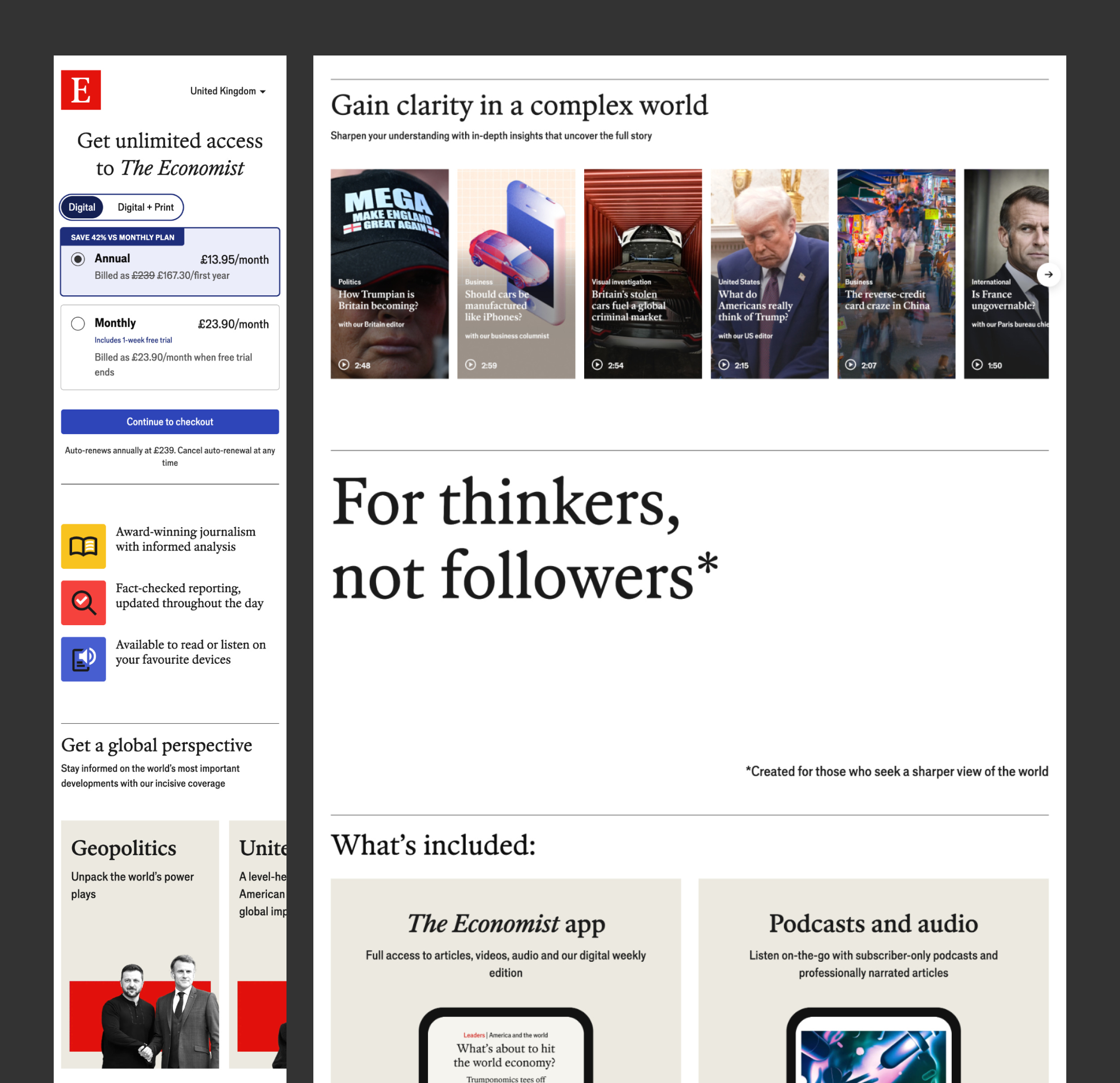
On the editorial products side, success may look like deeper engagement: more reading, listening, or watching of our journalism. These behaviours link directly to improved retention and renewal rates. Ultimately, our design efforts are judged by the value they unlock for both users and the business.
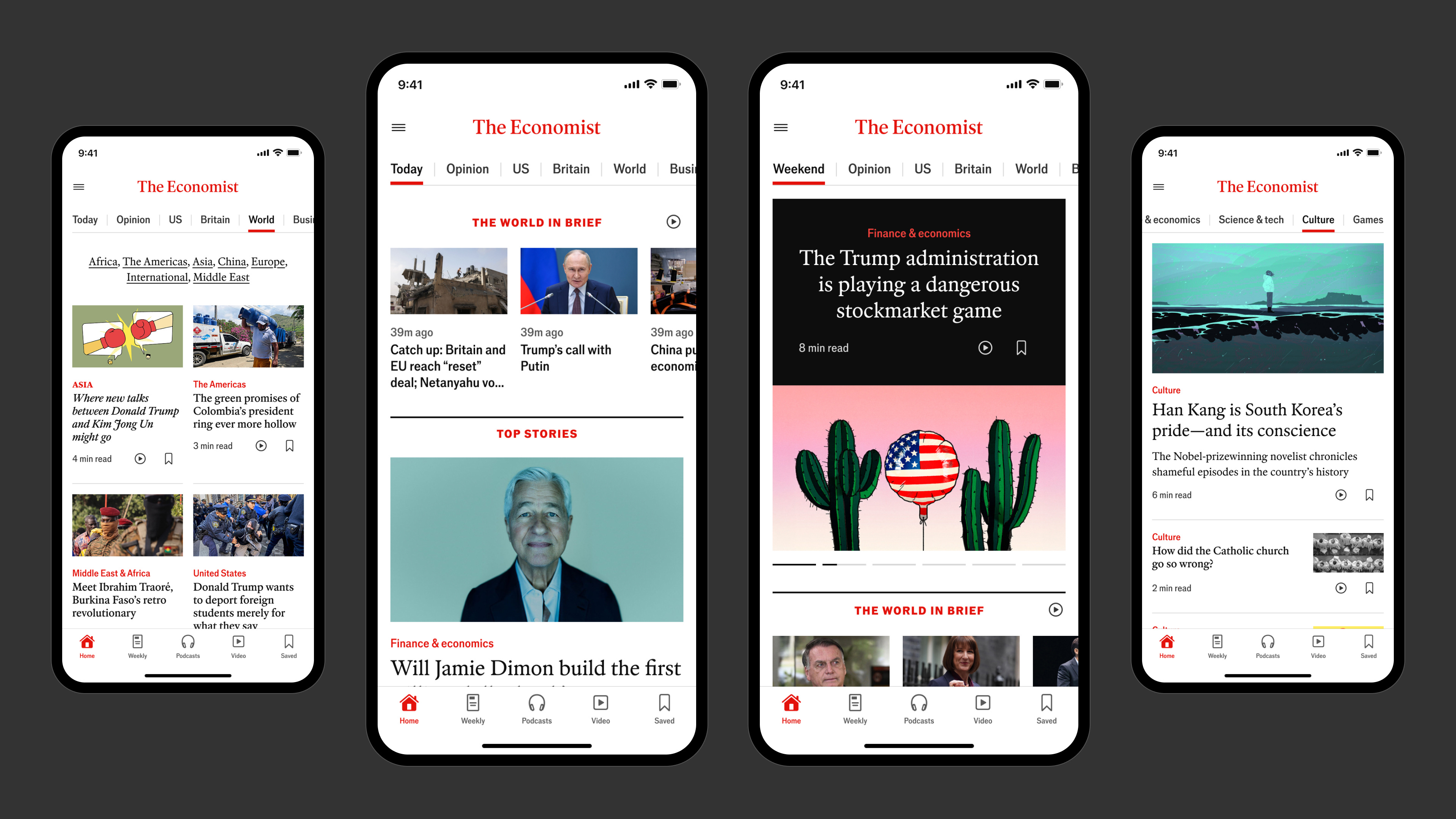
Design played an important role in reshaping our app experience - from setting the narrative to aligning stakeholders and honing execution.
We had invested in re-platforming to a native app environment which delivered significant user experience benefits around improved performance, speed and stability. This laid the groundwork for a richer app user experience: allowing us to better showcase our journalism in its different formats and improve discovery through better navigation.
We leaned heavily into prototyping. Not just to explore ideas, but to communicate vision. We used prototypes as provocations to engage stakeholders at different levels. Rather than rely on decks, we brought ideas to life - iterating variations of homepage components and layouts whilst evolving The Economist brand expression within the app.
This approach galvanised cross-functional teams and helped establish a shared vision for the app’s future: to deepen user engagement while strengthening editorial curation.
4. How do you interview designers?
We run a deliberately simple three-stage interview process.
The first round is a conversation with the hiring manager, either myself or one of the design managers. We review one or two pieces from the candidate’s portfolio - exploring their thinking, process and experience. It’s a chance for us to get a sense of who they are as a designer.
The second round is a deeper portfolio review with other designers. Here we assess their design decision-making, how they collaborate and where their strengths or gaps may lie. It’s also where we get a better sense of their craft and communication skills.
The final stage is focused on team and culture add, with cross-functional colleagues such as product managers, engineers or relevant stakeholders. We explore what they might bring to The Economist beyond design skills - how they work with others and how they might add to the team dynamic.
Importantly, we don’t run take-home design tasks. They’re often unrepresentative, overly time-consuming and offer little insight into day-to-day performance. Instead we base interview questions on areas from our internal skills matrix, which is what we use to support growth for designers in the team. This helps ensure consistency across hiring and internal development in areas such as craft, collaboration, communication and influencing skills.
5. What do you look for in designers?
For me, I always look for a core of strong visual sensibility. I’ve found that UX and interaction design skills can be coached and developed, but a sharp eye for design and aesthetic judgement are harder to grow. But this is not about style over substance, it needs to be backed up with solid usability and product problem solving abilities.
Beyond that, I look for what new perspective a designer might bring. That could mean a distinctive skill set such as motion design, accessibility or systems thinking. Or a diversity of background: agency vs in-house, tech vs media. These differences enrich the team and often introduce new ways of thinking.
I also value a growth mindset. Design is evolving rapidly. Tools are shifting, roles are blurring and AI is redrawing many boundaries. I want designers who are curious, adaptable and eager to keep learning. People who embrace change and help move the discipline forward.
Links to check out
Figma blog: How The Economist rolled out a digital-friendly typeface
Recording from Config 2025: Adam’s panel discussion on driving industry transformation
6. How is The Economist thinking about AI and the role design has to play?
Trust is foundational to The Economist. Our journalism is known for its rigorously fact checked opinion and analysis on the themes shaping the world. Therefore transparency is essential in how we incorporate AI - especially when it touches the editorial product.
Design plays an important role in signalling authorship: clear labelling, consistent styling and visual cues help users distinguish between human and machine-generated content. These signals protect the integrity of our journalism and maintain reader trust. We also have a high quality bar, so the output of these models as well as the front-end ease of use are important to us.
Within the design team, we’re in a phase of experimentation. We’ve run dedicated AI exploration sessions and team days to understand how emerging tools can improve our craft and workflows. Some designers use ChatGPT as a thinking partner: to unpack PRDs, plan workshops or distil documentation. Others are experimenting with tools like V0 and Lovable for rapid ideation and first drafts, or Figma Make to explore layout and interaction refinements.
This is not about replacing designers. It’s about enhancing what we do. Augmenting creative thinking, accelerating iteration and freeing up time for deeper work. Curiosity and craft remain essential; I see AI tools as simply becoming part of the designers’ toolkit.
The Economist Insider, a new premium video offering that lifts the curtain on our journalists and the spirited and constructive debates they have around critical global issues.
Link to check out:
7. What is The Economist’s stance on design systems and AI? How will these domains evolve together?
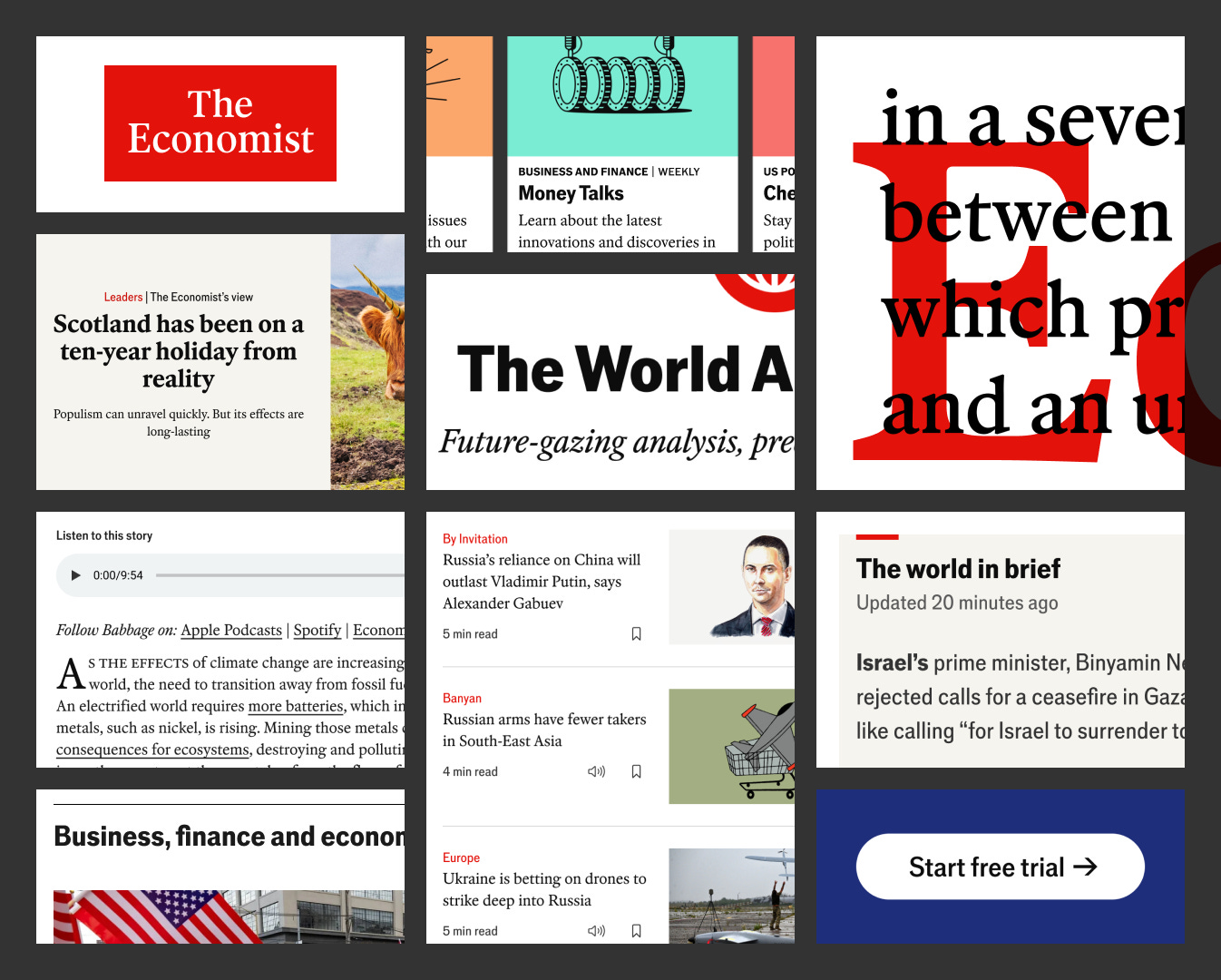
Over time, we’ve evolved our design system, Marber—named after Romek Marber, the distinguished graphic designer behind The Economist’s covers in the early 1960s. Marber provides the shared visual language, components and guidelines that underpin our digital products.
What’s becoming more interesting is how the structure of a design system enables AI. The use of variables and design tokens creates a direct bridge from Figma into AI-powered coding tools like Cursor. Outputs are more consistent and much closer to the end product, helping to make richer prototypes that capture design intent.
A well structured design system will remain table stakes. What changes with AI is the value it unlocks. The more robust the design system, the better the results you’ll get from AI-driven tools. The challenge for us is ensuring Marber keeps evolving at pace with our lean, cross-functional approach to its development.
8. How do UX Writers and Researchers collaborate with product squads, and what does this partnership look like in practice?
We have one UX writer/content designer in the design team. Our content designer and product designers aim to collaborate early in the design process and work side by side, depending on the content designer’s capacity.
On priority projects the content designer will feed into the overarching strategy, working alongside the designer, product manager and researcher on discovery work and leading in areas related to content, such as content strategy, defining the information needs of the user and how best to present it. Our content designer will get in the Figma file with the designers and jam with them. They’ll then collaborate with the designers and researchers for user testing, either doing specific language testing or supporting with testing the concept overall, and then working with the designer to iterate the design and prepare it for launch. This way of working means that content helps shape the product overall, rather than just being something that is added at the end.
Thanks to Adam for giving this detailed insight into the team at The Economist.
They are hiring a Principal Designer to work in the AI Lab in London, so if you’re keen to explore roles please do check this out.
Let me know your thoughts on this article. Until next time!
I learnt English by reading the Economist in college. The writing I picked up from the site scored me a speaking gig at United Nation.
I am very grateful that Adam shared the insider's view of how Design at the Economist works. Amazing read