
Design Hiring Observations
From the last few months

Hello! Below is a round-up of design hiring observations in a variety of topics over the last month or two. It’s raw, not very well edited, but I hope it's insightful.
TL;DR:
What companies are hiring for (Product Design focus)
Design Leaders not in demand right now
Design Leaders in demand right now
Reasons people are getting declined
There are SO many great opportunities in Europe
Interview processes are changing
The best time to hire juniors is now
Three types of Designers most in demand
Companies are being more flexible with how they hire
Designers don’t know if they will end their careers in design
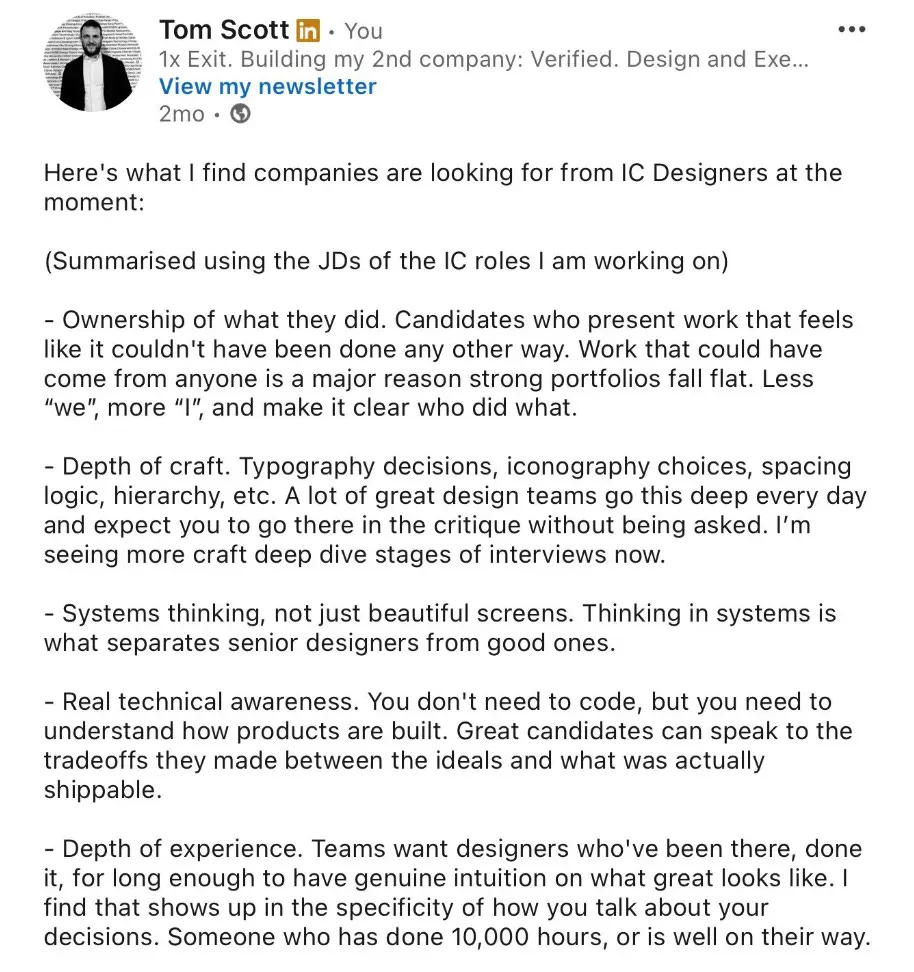
1. What companies are hiring for (Product Design focus)
These are actual requirements from a client.
Ownership & builder instinct. Have they driven outcomes end-to-end, or have they mostly executed within someone else’s framework? We want people who identify problems and solve them proactively, not people who wait for specs.
Visual craft & UI execution. Portfolio must demonstrate exceptional visual quality: typography, spacing, colour, and interaction detail. This is non-negotiable.
Systems thinking. Experience designing across interconnected surfaces (desktop + web + mobile, or similar). Bonus if they’ve contributed to or built design systems.
Real AI fluency. AI tools (LLMs, Claude Code, Cursor, etc.) should be embedded in how they actually work.
Product sense. Evidence of shaping what got built, not just designing what was specced. Metrics, research, and business outcome awareness alongside design work.
Communication quality. Clear, specific, opinionated writing. If their portfolio copy is full of buzzwords and you can’t tell what they actually did, that’s a red flag.
2. Design Leaders not in demand right now
These were actual requirements from a client. Still super relevant.
A process-first manager. Someone who optimises rituals, tracks progress, and focuses on the org chart. This role is about leading from the work, not just managing the work.
A Design Ops person in disguise. Someone who excels at coordination but is disconnected from taste, detail and creativity.
Someone who is tied to playbooks from the last decade.
Someone who needs permission to act; passive leaders won’t survive at many orgs.
Someone who’s only comfortable in stable, slow-moving environments. This is a job for someone who thrives in change, sees ambiguity as an opportunity, and stays calm under pressure.
3. Design Leaders in demand right now
These were actual requirements from a client last year. Nothing has changed.
Proven design leader and passionate about the craft of shipping software.
Deep product taste and craft excellence, with sharp eyes for detail, strong creative instincts, and a relentless push for quality across UX and Visual Design.
Strong product partnership skills who can align with product and engineering leads to drive strategy, make smart tradeoffs, and ship great work fast.
First-principles thinker who thrives in ambiguity and not bound by traditional playbooks, but excited to invent new ways of working and building.
Passionate about technology. Someone who is a product person.
High agency and executional energy who spots what’s missing, takes initiative, and leads from the front.
4. Reasons people are getting declined
Exploratory portfolios - for some this shows builder mindset, but some companies are not looking for this, they are looking for more “final polish”. Portfolios that feel exploratory and never fully resolves. Lots of things that get to 70% and stop. Not much restraint and not much evidence of pushing work to polished.
Showcasing vibe-coded prototypes that looked very vibed.
People with a very focused UX background, without a portfolio demonstrating well-crafted visual products, will struggle to get through the portfolio review for IC roles. You need to lean on other areas to stand out.
5. There are SO many great opportunities in Europe
Just this last month, I’ve placed 2 incredible designers in Europe from the US.
The number of top-tier AI-native companies hiring designers in Europe is incredible.
For a long time, it felt like you needed to leave Europe to do the best work of your life. The opportunities are abundant now. I speak to people on a weekly basis who are keen to move here for a better quality of life but do not want to compromise on quality of work. You definitely will not.
Just a snapshot of companies hiring designers in Europe:
Lovable (London/Stockholm)
Attio (London/Remote)
ElevenLabs (London/Remote)
Nothing (London)
Mistral AI (London/Paris)
Helsing (London/Paris/Berlin/Munich)
Fin AKA Intercom (London/Berlin/Dublin)
Legora (Stockholm)
Synthesia (London/Remote)
There has never been a better time to be a designer in Europe.
6. Interview processes are changing
Tasks are back on the agenda: Companies want to test how someone works in a real scenario. A lot of the work is new to everyone, so no one has figured this out, so it’s hard to test without seeing work under real conditions. The tasks are more “prototype this with AI and walk us through your thinking.” This also includes leadership roles for some companies, which makes sense if they are looking for hands-on player coaches — they must be able to do the work also.
Work trials are becoming a thing in hiring decisions. Usually, because what people are building is so new, there is no way to judge if they will be the right hire based on previous experience.
7. The best time to hire juniors is now
I don’t understand why more companies aren’t hiring early-stage designers.
Speaking to earlier stage designers in 2026, a lot of them are:
AI-native by default. Shipping PRs etc.
Can bring fresh perspectives. No legacy mindset. Nothing to unlearn.
They are more mouldable and adaptable.
They are good “do-ers” and can partner well with a Principal for example.
I understand why some companies are not set up for junior designers, and I'm not saying every company should hire them, but I can’t help but feel there are a lot of companies that could probably hire more, but they are not thinking about the future, and are just in a survival mindset.
Hiring earlier-stage designers is just about building a bench for your IC team as people move on and get more senior.
8. Three types of Designers most in demand
The most in-demand IC’s I see are:
Product Designers who ship
Design Engineers
Brand Designers
The demand for brand design is off the charts.
9. Companies are being more flexible with how they hire
I have seen 3 needs for fractional designers and leaders recently:
Advising start-ups.
Plugging a leadership gap.
Executional design support.
Fractional is a fancy term for freelancing for many. Someone who is fractional should have different clients at once, these roles often come from your network 99% of the time.
I’m seeing a lot of need for very strong, visually focused designers to support design teams with capacity or fill a leadership gap for a few months (2-3 days per week) whilst the company hires a new permanent design leader.
10. Designers don’t know if they will end their career in design
It feels like people are more stressed, expectations are through the roof, creativity feels like it's being decimated, and it’s leaving a lot of designers feeling burnt out.
The obsession with not having any people managers at all is causing a serious decline in the design team's health, IMO. So many dysfunctional and toxic design teams out there, ones that you would think from the outside have it together.
For that reason, I think we’ll see more designers move towards freelancing, start their own studios, or build their own products to take back control and find joy in their work again.
I feel like this is a good place to remind you that life is not about burning yourself for the sake of feeling busy. It’s about balance. It’s about enjoying your time here. Your career is a vehicle to living a balanced life. You are not your career.
It has led to a lot of designers I speak to genuinely debate if they will end their careers in design/tech.
Excited for the remaining 6 months of 2026. Where is time going?!