

I am excited to bring you a “behind-the-scenes” look into the product design team at Legora with Anton Reimertz. I first worked with Legora in January 2025 when I placed the Founding Designer, Bert. At the time, they had 20+ people and were called Leya; now they're 1000+ people, with multiple offices globally, and growing rapidly.
I’ve always been impressed by their emphasis on design from the start and how they’ve maintained it through rapid growth.
If you don’t know about Legora, they are building the agentic operating system for legal work, defining a whole new category.
Here are just a small number of takeaways I took from this article:
Coherence starts with structure: a central design hub. Product design and design systems with designers embedded in product teams.
Design is intentionally lean; designers own broad surface areas across product, brand, motion, systems and web.
Coherence, craft, and cross-functional ambition are inseparable when building a premium legal product.
Anton Reimertz is Head of Design at Legora, where he leads the product design team. He joined in August 2025, when the team was one designer and dozens of engineers, and has since grown it to more than ten designers across Stockholm, London and New York.
1. How is the design team structured at Legora?
The design team is actually three distinct groups: product design, design systems, and the Design Studio.
Product design works as a hub-and-spoke model. The hub is the design function, and the spokes are designers embedded in product teams. Sometimes a designer works across two teams, sometimes one. It depends on how much user-facing problem surface area there is.
With agentic software, you can shrink that surface area a lot by making the agent the entry point to everything. But we serve so many different practice areas, types of lawyers, and use cases that we need something to hold the user experience together. That’s what the hub is for.
Design systems ensure our designs land as intended and increasingly give our agents a language to build interfaces. The Design Studio works on a project basis: either it drops into an existing team to raise the bar on a high-stakes surface, or it owns a project end to end, from concept through shipped code.
Across all three groups, we meet multiple times a week to avoid duplicating work and run live critiques. We’ve built a system that makes design judgment available on demand to everyone on the team.
Tom: How do product design and the brand studio collaborate?
It comes down to two things.
One is the shared building blocks we want to carry from our marketing surfaces and brand moments into the product: typography, colour, illustration.
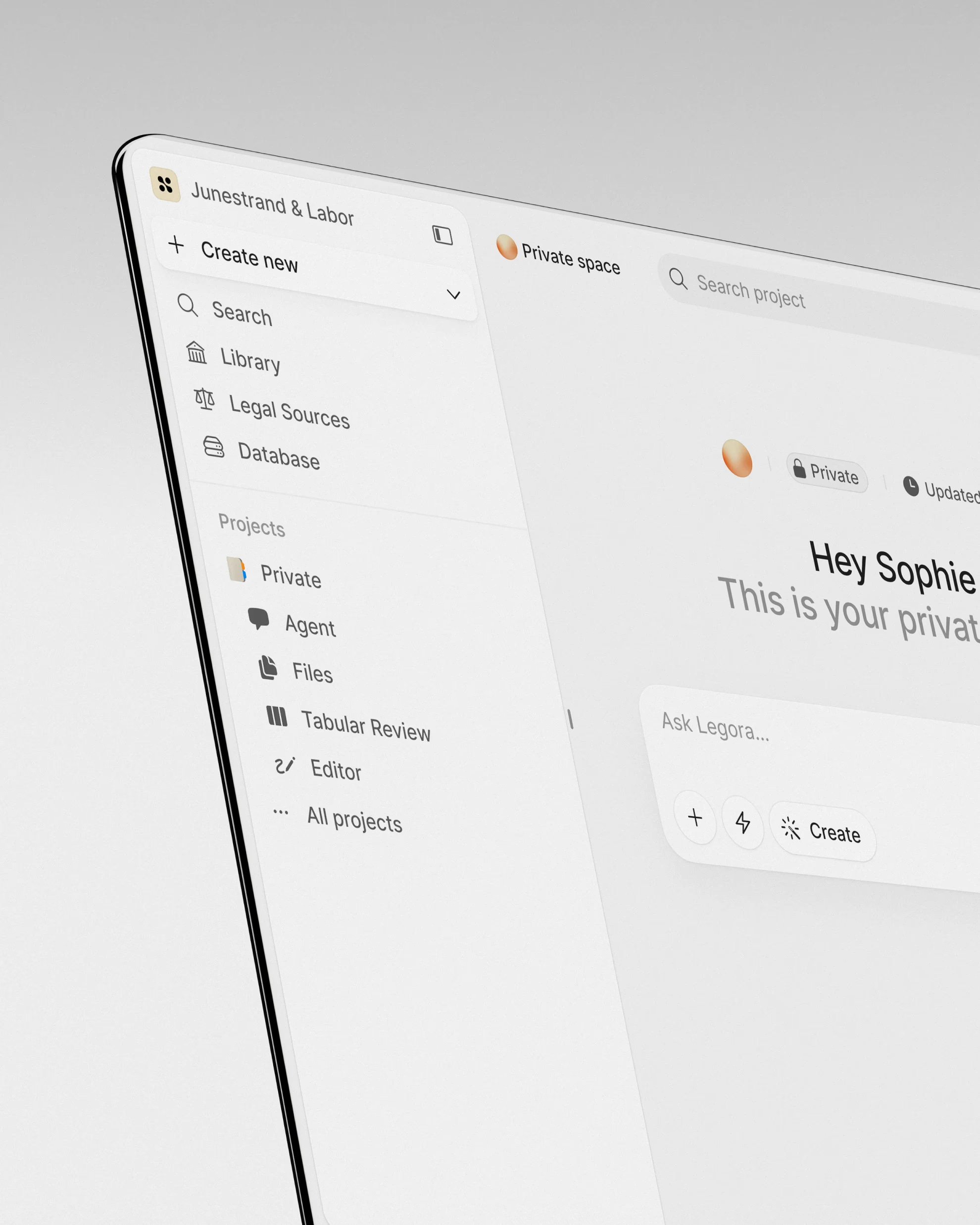
But there are subtler things, too. I led our latest visual identity refresh. If you go on our website, you’ll see a lot of glass effects. Where that came from was: we want to position Legora as a layer in the world of our customers, the lawyers. We’re an augmentative layer that makes them a lot more efficient at executing their judgment. So can we pull some of that into the product? Yes. In the product interface, we have glass effects in very subtle ways.
The other thing runs from the product side: how we bring the product back into our marketing. We’re a technology company, and people are interested in what we’re building. How do we show the product when it’s not in the product, on an ad or a LinkedIn post, in a way that feels authentic and true to our customers?
Much of the collaboration is designer-to-designer. We stand on a shared foundation, and I want the seam between brand and product to be basically nonexistent.
2. How does Legora measure design success?
Design success is product success. At a high level, we measure ourselves against the same business objectives everyone else measures against.
To make this tangible, a lot of signal comes directly from customers. Why did someone choose Legora, or not? Sometimes there’s signal there that comes down to usability or how intuitive something is. And when there’s negative signal, that’s something we care a lot about.
We also get a lot of feedback from people using the product. They can report issues in-app, and we have automated ways to pattern-match against our objectives.
Tom: What does Max care about when it comes to design?
He cares a lot about having a product that’s clearly superior and differentiated.
My job is to translate that ambition into the experience itself. When Max or anyone on our commercial team demos Legora, the quality of the product should be immediately obvious.
3. How does Legora interview designers?
We currently have four stages. Before any interview stages, we screen portfolios.
My bar for getting an interview is actually quite low, yet it still rules out most candidates. I’m looking for just one thing that catches my eye, where it’s obvious someone really cared. I don’t have time to go through every case study. Having reviewed thousands of portfolios, I’ve found there’s usually an inverse correlation between how many words are in a portfolio and how good the designer is. The best designers I’ve interviewed don’t have much in their portfolios, but they have one or two pieces where they were clearly at the top of their game.
Stage one is the hiring manager interview with me. If I’m going to spend 45 minutes with someone, I can at least interrogate that one thing. Was it a one-off, or can they replicate it in a different context? How they approach problems, what they believe they’re good at, who they are as a designer, where they want to go.
After that, stage two is the case interview. I want our most senior designer there, because he’s closest to the work. If he feels this person can do the work required for the role, not necessarily match his level, that’s a very strong signal.
Next stage three is a stakeholder interview with a PM. This is more of a collaborative case, and it’s the stage where a lot of designers trip up. The reality of our space is that no one on the design team is a lawyer. Out of several hundred candidates, maybe two had any kind of legal background. We’re looking for people who can quickly unpack a problem, break it down into its component parts, and assemble a solution together with a PM.
And finally, stage four, the final round, is an exec round. It’s a chance to cover anything the earlier conversations didn’t fully address, and for the candidate to hear first-hand where we’re going. We want everyone joining the department to share the vision and mission and feel excited about it.
4. Who thrives at Legora?
We’re not trying to hire the same profile. We look for spikes we don’t have in the team and bring them in. But a few things are true for everyone.
The first is being comfortable with ambiguity. We’re building a new category. Everyone’s learning as we go, and there’s a lot of ambiguity in that. You need to be able to figure out how to get the best context on the problem you’re trying to solve. Some of that knowledge exists in the building, some you need to go out and get, some lives in data.
The second is being product-minded. You can’t only be good at craft, although that’s important too. Craft is a baseline requirement; you don’t get an interview without it. For us, it’s getting less and less important. Not because I don’t believe in it, but because we’ve invested a lot in our design system and lifted the floor quite a lot. A year ago everything was bespoke, everything was net new. Now we need intelligence plus craft.
And the third is being able to work the entire funnel. From the customer problem, unpacking it, talking with users, exploring the solution space, getting the team with you and excited about where we’re going, getting to a solution, and then helping make sure it actually gets into production with engineers. As a designer at Legora, the experience that lands with customers is the one you get measured against.
5. Does the team have shared design principles?
We have a couple, but they’re more about how to be an effective designer at Legora.
One is that there is only one designer. Legora should feel like it was designed by one person. The user benefit is obvious: we want patterns learned in one part of the product to carry over into the next, so people don’t have to relearn everything.
Another one is “fight the organisation”. When you’re working in a team, it’s so easy to optimise for your local space. But the role of a designer is to take a step back: what is the problem we’re trying to solve? Maybe the solution is partly over here, and partly in the team I’m in. If that’s true, go design the entire thing. Then maybe it’s a conversation with the respective product leaders: the solution isn’t only in your space.
It sounds nice to go and write a document that encodes everything. But those things become annoying to maintain when you’re redesigning the product every six months because the technology is changing so fast. We’re learning new things all the time. So we’ve taken a different approach to principles and patterns.
6. How is the design team using AI?
When I see designs, most of the time I’m not looking at Figma screens. We still design in Figma because we often need a canonical reference: either to kick off an agent to build something later, or because product marketing wants to pull UI, and that’s often still easier in Figma. But Figma has been constrained to the middle. The start is usually a prototype, often in Claude Design, ChatGPT, or sometimes directly in the production environment as a front-end prototype.
What I tell the team is: I don’t care what tool you use. At least at the beginning, the most important thing is to exhaust the solution space as quickly as possible and, together with our teams, get to a solution that’s at least 80% of the way there. If we can get there quickly, it unlocks the rest of the team to start scaffolding out the tech, and we can start lining up customer conversations and design partners. Then we get to the higher-fidelity work with more time.
We care about sweating the details. But compressing the initial discovery is critical, especially in a world where the entire build time is being compressed. It’s hard for designers to justify weeks of design sprints anymore. Pick the tool that gets you to that point as fast as possible.
7. What is Legora’s stance on design systems and AI?
My first hire was a design systems engineer. When I joined, we had one designer on the team, Bert, and dozens of engineers. With the team growing, that would eventually have led to the design as intended and the design as implemented diverging. So I wanted one person whose job was to make sure we matched the design intent with how it landed with our users.
Back then, it was mostly Figma, so I made sure what was in Figma was what came out the other end. That was October 2025, and we were already talking about the ultimate prize: automating UI creation, enabling designers to go from vision to finished UI.
What’s changed since then is that the design system’s role is now to give agents a language. If anything, the design system has become more important for us. We have a dedicated design systems group sprinting at this.
Tom: How is that affecting how you think about hiring?
Part of it is finding people who are very high-craft and can decompose use cases into interfaces, patterns and components, and systematise them. That’s the design system part. The other part is people with product sense who can work end to end: be in a user interview, take the insights, explore the solution space, take it down to a solution, and help get it shipped. Some designers work on a problem surface, while others focus on how interfaces decompose into patterns and components. You can find these skills in one person, but it becomes harder to operationalise, and especially to justify systems work, when you’re also designing the next big innovation.
8. How are you maintaining high standards for the design team as the company scales?
I can start with what I don’t believe in. I’ve been on design teams where you try to codify your principles into one master document: this is how we’re all going to do things. That breaks down when technology advancements mean you’re redesigning the product every six months, and the team is changing.
We want the design of Legora to feel like it was designed by one person. But we’re not one person. We’re more than 10 people today, and we might be 20 by the end of the year. So how do we put in place a system that lets designers pull design judgment whenever they need it, based on the things we agree are good design?
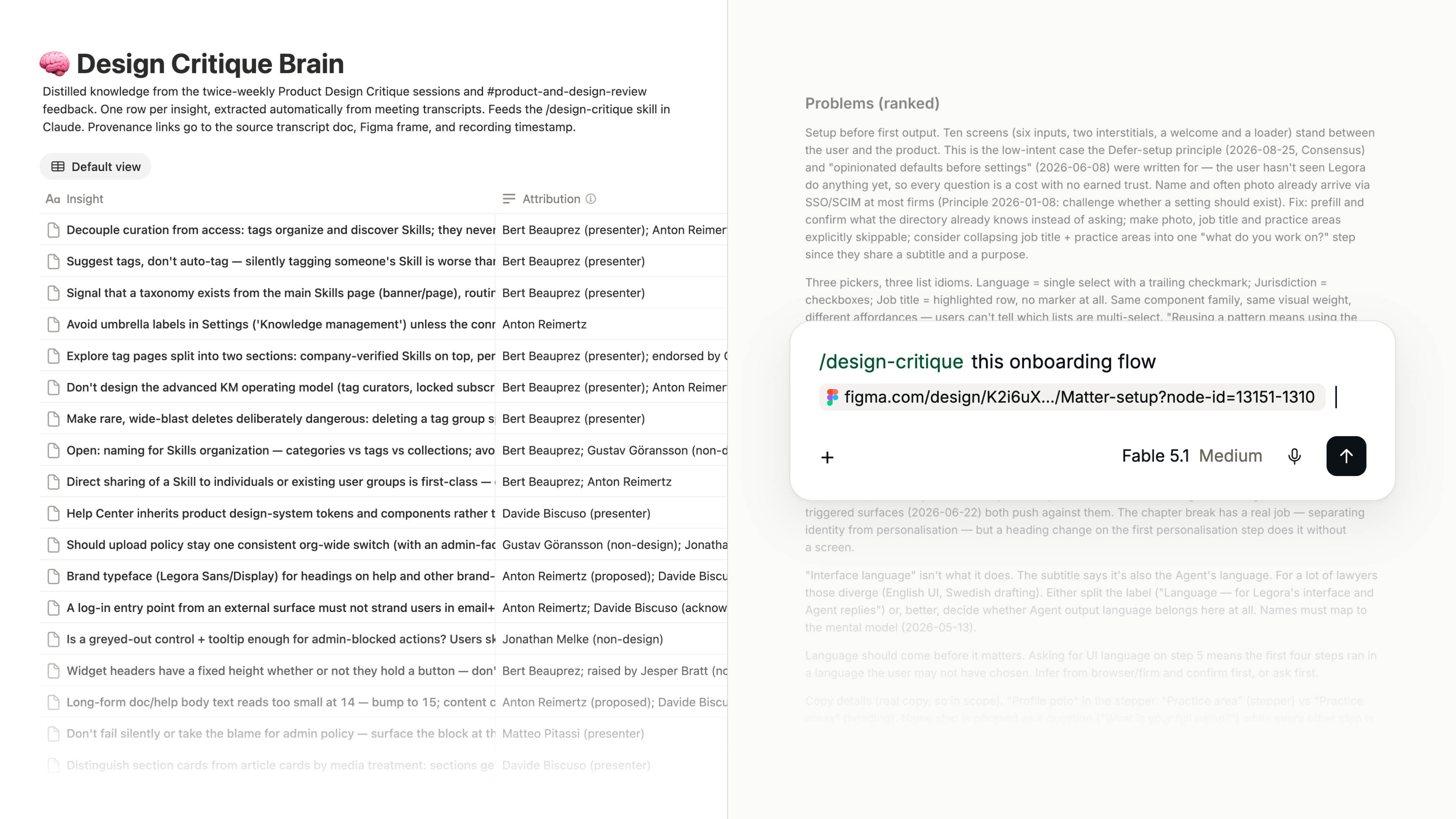
The way we do it today: we record everything. All the live design critiques we run, and all async design reviews. We have a Claude workflow that looks at the transcript and the artefacts shared on screen and pulls out insights. What decisions were made. What patterns we were talking about, and how a pattern elsewhere in the product applies here. And principles: sometimes a principle gets mentioned without being called a principle. I might say “we can never have more than three panels,” and it picks up on that. It categorises everything into decisions, patterns and principles, notes whether it was a consensus view or a single voice, and puts it in a database in Notion.
That database on its own isn’t very usable; it’s thousands of entries. But we have a skill you can run on anything. You can run it on prototypes, Figma files, the production environment or even a napkin sketch. It captures our judgment and makes it available to any designer, anytime. That’s how we scale judgment, by making it available on demand.
Beyond judgment, we’re automating what we can. For example: We automatically check PRs against our content guidelines, accessibility requirements, motion guidelines, and design system.
Tom: Do you think AI will ever outpace human taste?
If you don’t give an LLM any context and ask it to design something, you get the common patterns it has learned. Not everything needs to be novel, but if you open Legora, I don’t want it to look and feel the same as every other software product. There needs to be something that makes it unmistakably ours. Some of that is aesthetics, some of it is how we solve problems in a unique way.
If you don’t supply the models with something uniquely yours, you’re not properly applying taste. There’s some amount of taste that’s general good practice. But there’s some amount that’s hyper-specific to the business you’re trying to create, the industry you’re in, your users, and the DNA of the company.
Tom: Has there been a time recently when the need to ship compromised quality?
In a world where building software is increasingly commoditised, it’s very easy to skip the part that makes software enjoyable and delightful to use. You can tell an LLM to solve any problem. It doesn’t mean it will solve it in a way that’s true to you. That has definitely happened at times.
When we slip on quality, we see it as a process problem: how do we fix the root cause instead of playing whack-a-mole? Investing in the design system and the judgment layer raises the floor for everyone. It doesn’t mean anyone can vibe a perfect solution to everything, at least not yet.
9. What work in the last 12 months are you most proud of?
That’s my entire journey at Legora. When I first joined, what kept me up at night was: how am I going to get the people in, make them really good, and have them do the right things? So I’d attribute it to the team we’ve built: how quickly we’ve scaled a design function that can operate at this scale, with this quality and this velocity.
There’s a lot more for us to figure out, especially now that we’re growing the team in new geographies. But I’m very excited about where we can take the design team from here.
Thanks to Anton for this detailed run-through of the design team at Legora. If you want to join the rocket ship and do some of the best design work of your career, defining a new category, Legora is hiring. Lots of people.
Here are the current live roles:
The glass effect is the detail I'd underline: it started as a positioning idea (Legora as an augmentative layer over the lawyer's own judgment) and only then became a material, which is the right order. As design systems increasingly give agents a language to build interfaces, the hard part is passing on that reasoning and not just the token, because an agent that only knows "use glass" will put it everywhere. Keeping the seam between brand and product invisible gets harder once agents are building on both sides of it, so the "why" has to be written into the system too.